
Introduction
A head injury can affect a person in many different ways. Some patients may have problems with movement, balance, memory, speech, attention, or daily activities. Because of this, recovery may require more than rest alone. A structured rehabilitation programme can help patients work towards better function, confidence, and independence.
At RR Neural Rehab in Erode, we provide personalized head injury rehabilitation based on each patient’s condition, abilities, and recovery goals. Our approach may include physiotherapy, occupational therapy, speech therapy, cognitive support, mobility training, and daily activity practice.
Most importantly, every recovery journey is different. Therefore, our rehabilitation team focuses on individual needs rather than using the same programme for every patient.
What Is Head Injury Rehabilitation?
Head injury rehabilitation is a structured programme designed to support people who have experienced a head injury or traumatic brain injury.
A head injury may affect the brain’s ability to control movement, communication, concentration, memory, behaviour, coordination, and daily tasks. Therefore, rehabilitation may focus on several areas at the same time.
For example, one patient may need help with walking and balance. Another patient may need support with hand coordination, speech, memory, or concentration. As a result, the rehabilitation plan is usually personalized.
At RR Neural Rehab Erode, our goal is to help patients improve functional ability and participate more confidently in everyday life.
Why Is Rehabilitation Important After a Head Injury?
After a head injury, some patients may find it difficult to return to their normal routine. Simple tasks can become harder than before.
For example, a patient may experience difficulty with:
- Walking
- Balance
- Coordination
- Memory
- Concentration
- Speaking
- Understanding language
- Hand movement
- Daily activities
- Returning to work
Because of these challenges, rehabilitation can provide structured support.
In addition, regular rehabilitation helps the patient practise important skills step by step. Therefore, it may support better independence and safer participation in daily life.
Common Problems After a Head Injury
The effects of a head injury can vary from person to person.
Some patients may experience physical problems, while others may have cognitive or communication difficulties. In some cases, several problems may occur together.
Common challenges may include:
- Weakness in the arms or legs
- Poor balance
- Reduced coordination
- Difficulty walking
- Headache or tiredness
- Memory problems
- Reduced concentration
- Slow thinking
- Speech difficulties
- Behaviour changes
- Difficulty with daily tasks
Therefore, a complete rehabilitation assessment is important before planning therapy.
Personalized Head Injury Rehabilitation in Erode
At RR Neural Rehab, rehabilitation begins with understanding the patient’s current condition.
First, the team looks at mobility, balance, coordination, communication, daily functioning, and other difficulties. Then, a personalized rehabilitation programme is planned.
Depending on the patient’s needs, the programme may include:
- Physiotherapy
- Occupational therapy
- Speech therapy
- Cognitive activities
- Mobility training
- Coordination exercises
- Daily activity practice
- Family guidance
As the patient progresses, the rehabilitation plan may also be reviewed and changed.
Therefore, treatment remains focused on the patient’s current needs and recovery goals.
Physiotherapy After Head Injury
A head injury may affect strength, posture, balance, and movement.
Therefore, physiotherapy can be an important part of head injury rehabilitation.
Physiotherapy may include:
- Strengthening exercises
- Balance training
- Walking practice
- Posture correction
- Stretching
- Coordination exercises
- Transfer training
- Mobility practice
For example, a patient who feels unsteady while walking may practise standing and stepping with support. Similarly, a patient with weakness may receive exercises to improve movement and control.
The aim is to support safer mobility and greater independence.
Occupational Therapy for Head Injury Recovery
Occupational therapy focuses on helping patients perform everyday activities.
After a head injury, a person may have difficulty with dressing, eating, writing, using objects, cooking, or completing household activities.
Therefore, occupational therapy may include:
- Hand coordination exercises
- Fine-motor activities
- Writing practice
- Dressing practice
- Grooming activities
- Eating-related tasks
- Daily living activities
- Functional task training
In addition, occupational therapists may suggest ways to make daily tasks easier and safer.
As a result, patients can work towards greater independence in their routine.
Cognitive Rehabilitation and Concentration Training
Head injury can affect memory, attention, concentration, and problem-solving.
Therefore, cognitive rehabilitation may be included in the recovery programme.
Activities may focus on:
- Attention
- Memory
- Planning
- Problem-solving
- Following instructions
- Hand-eye coordination
- Sequencing tasks
- Concentration
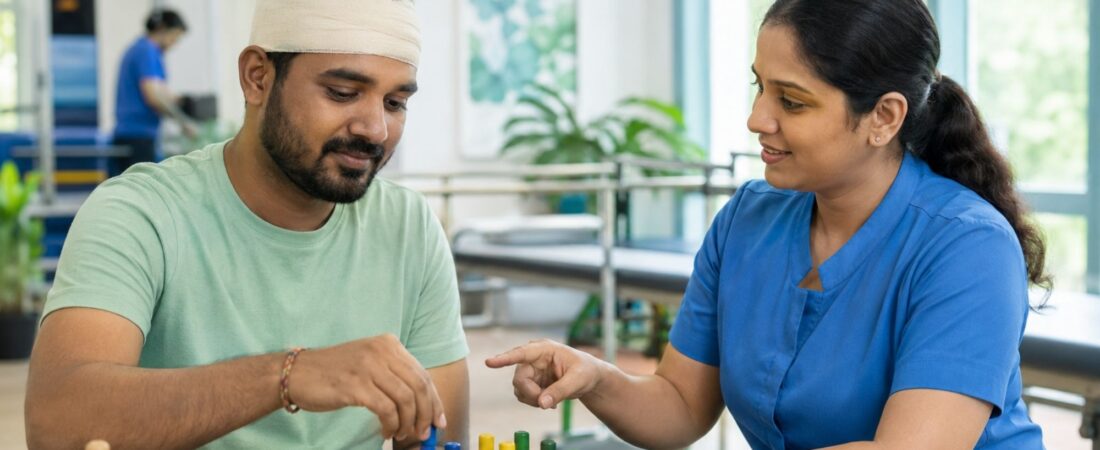
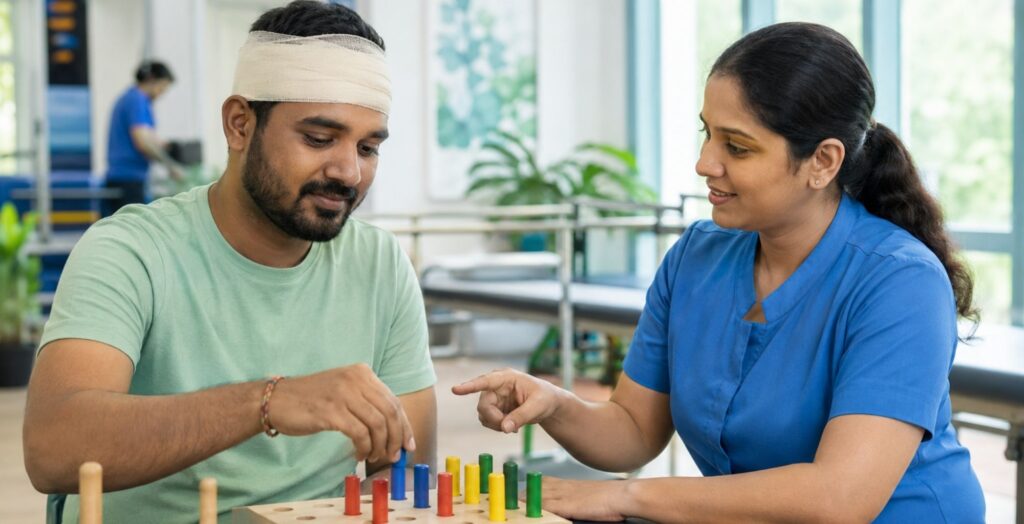
For example, therapists may use pegboards, matching activities, picture tasks, simple puzzles, or structured daily activities.
These exercises are designed to help patients practise thinking and functional skills in a safe environment.
Speech Therapy After Head Injury
Some patients may experience difficulty speaking or understanding language after a head injury.
Speech therapy can support patients with:
- Speech clarity
- Language understanding
- Expressing thoughts
- Voice control
- Communication
- Swallowing difficulties
Therapy is planned according to the patient’s specific communication needs.
In addition, family members may receive guidance on how to communicate more effectively with the patient.
This can make everyday conversations easier and more comfortable.
Balance and Coordination Training
Balance and coordination are important for safe movement.
However, a head injury may affect these abilities.
Therefore, rehabilitation may include:
- Sitting balance exercises
- Standing balance
- Weight shifting
- Hand-eye coordination
- Step training
- Walking practice
- Functional movement activities
Initially, some patients may need more support. Later, exercises may be progressed based on improvement.
The goal is to help patients move with greater control and confidence.
Hand and Arm Function Training
A head injury can also affect hand movement and coordination.
This may make it difficult to hold a cup, use a spoon, write, or handle small objects.
Therefore, therapy may include:
- Grip exercises
- Pegboard activities
- Reaching tasks
- Object handling
- Finger exercises
- Hand-eye coordination
- Fine-motor training
These activities help patients practise movements that are useful in daily life.
Daily Activity Training
Rehabilitation is not only about exercises. It is also about helping patients return to meaningful daily activities.
Therefore, training may include:
- Getting in and out of bed
- Sitting and standing
- Dressing
- Eating
- Grooming
- Walking safely
- Using the bathroom
- Moving around the home
- Performing simple household tasks
By practising these activities, patients can gradually work towards greater independence.
Family Involvement in Head Injury Rehabilitation
Family support can make a big difference during recovery.
After a head injury, the patient may need help with movement, communication, memory, or routine activities.
Therefore, family members may receive guidance on:
- Safe mobility
- Communication support
- Daily activity assistance
- Home exercises
- Encouraging independence
- Monitoring changes
Most importantly, family involvement helps create a supportive environment outside the rehabilitation centre.
Multidisciplinary Head Injury Rehabilitation
Head injury may affect several areas at the same time.
Therefore, a multidisciplinary team can be helpful.
At RR Neural Rehab Erode, the rehabilitation team may include:
- Rehabilitation doctors
- Physiotherapists
- Occupational therapists
- Speech therapists
- Other rehabilitation professionals
Each professional focuses on a different part of recovery.
However, the team works towards common functional goals.
As a result, the patient receives coordinated rehabilitation rather than separate and unrelated treatments.
When Should Head Injury Rehabilitation Begin?
The right time to begin rehabilitation depends on the patient’s medical condition.
Once the patient is medically stable, the treating doctor may recommend rehabilitation.
Starting rehabilitation at the right time can help identify problems early and begin suitable therapy.
However, even patients who had a head injury some time ago may still benefit from an assessment depending on their current difficulties.
Therefore, speaking with a rehabilitation professional can help decide the next step.
How Long Does Head Injury Rehabilitation Take?
There is no fixed recovery period for every patient.
The duration of rehabilitation depends on several factors, including:
- Severity of the injury
- Areas of the brain affected
- Patient’s age
- Physical ability
- Memory and concentration
- Communication
- Balance
- Participation in therapy
- Family support
Some patients may improve faster, while others may need longer rehabilitation.
Therefore, treatment is usually based on progress rather than a fixed number of days.
Returning to Work After Head Injury
Returning to work can be an important goal for some patients.
However, head injury may affect concentration, memory, communication, stamina, and physical ability.
Therefore, vocational rehabilitation may help.
Vocational rehabilitation may include:
- Computer practice
- Writing
- Planning
- Work-related tasks
- Concentration exercises
- Communication training
- Work tolerance
- Gradual return-to-work planning
The aim is to help the patient return to suitable work as safely as possible.
Why Choose RR Neural Rehab in Erode?
RR Neural Rehab provides personalized neurological rehabilitation focused on practical recovery goals.
Our approach includes:
- Individual functional assessment
- Personalized rehabilitation plans
- Multidisciplinary team support
- Mobility and balance training
- Cognitive activities
- Daily living training
- Communication support
- Family guidance
- Progress-based rehabilitation
Most importantly, our focus is on helping patients improve functional ability, confidence, and independence.
Other Neurological Conditions We Support
In addition to head injury rehabilitation, RR Neural Rehab also provides rehabilitation support for:
- Stroke
- Spinal injury
- Parkinsonism
- Multiple sclerosis
- Cerebral palsy
- Other neurological conditions
Each condition affects patients differently. Therefore, therapy is always planned according to individual needs.
Therapies Available at RR Neural Rehab
Physiotherapy
Supports mobility, strength, balance, posture, and walking ability.
Occupational Therapy
Helps improve daily living skills, hand function, and independence.
Speech Therapy
Supports speech, language, voice, communication, and swallowing.
Vocational Rehabilitation
Helps patients rebuild functional and work-related abilities.
Start Your Head Injury Rehabilitation Journey
Recovery after a head injury can take time. However, structured rehabilitation can support patients as they work towards better movement, communication, concentration, confidence, and independence.
At RR Neural Rehab in Erode, our team provides personalized neurological rehabilitation based on each patient’s condition and goals.
If you or a family member requires head injury rehabilitation in Erode, contact RR Neural Rehab to learn more about available therapy options.
Phone: 93849 57999 / 93848 67999
Email: rrneuralrehab@gmail.com
CTA: Book a Rehabilitation Consultation